
NIGHTINGALE MONTESSORI
Reimagining Education Since 1978
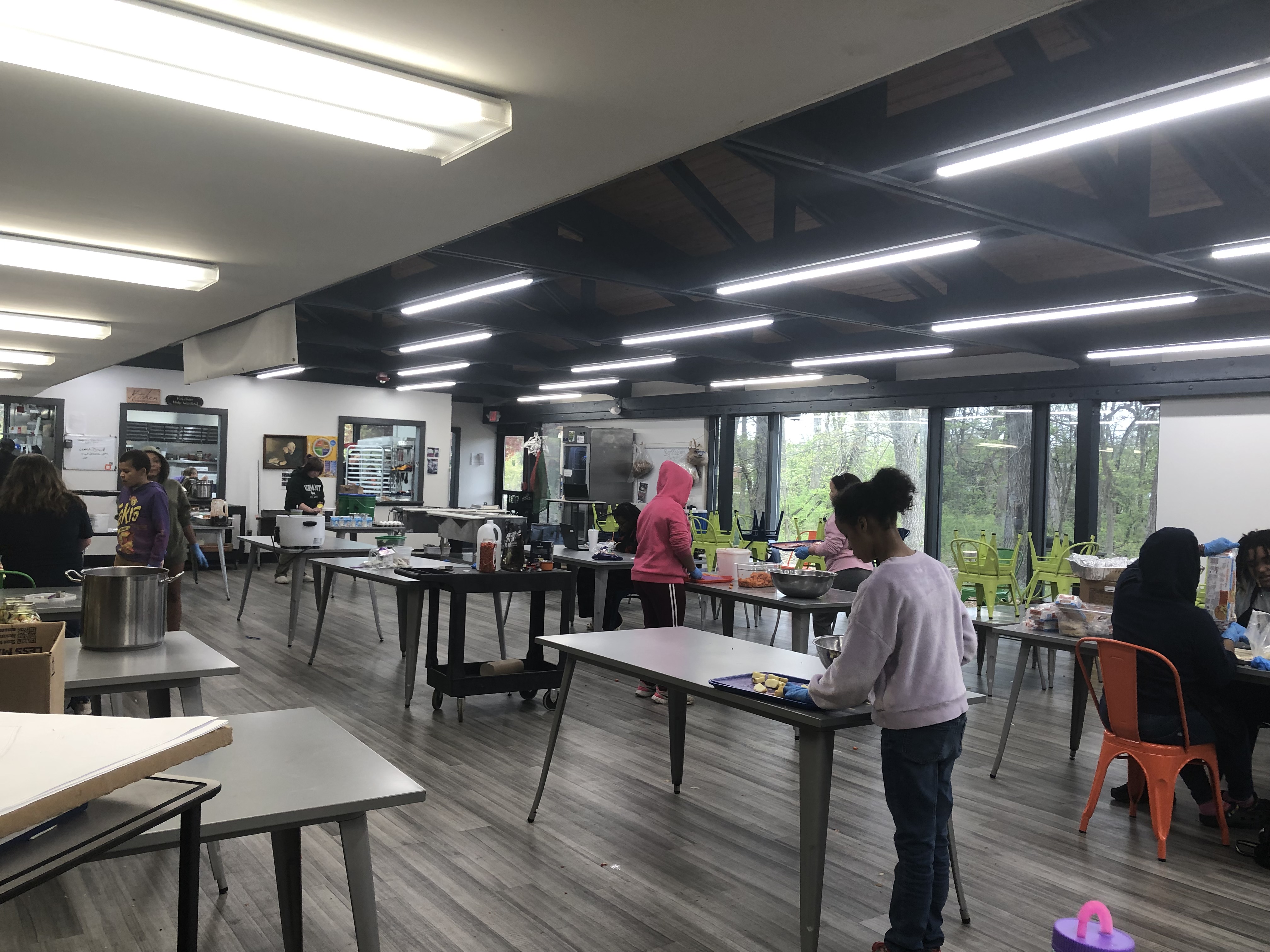
Edible Schoolyard Experience: Learning Gardens and a Teaching Kitchen. Nightingale dedicates more than half of its campus at 2525 Limestone Street to sowing the seeds of a permaculturally designed Edible Schoolyard. A love of the natural world and organic farming provides an integrating context for experiential learning. Student teams work to enhance their outdoor “classrooms” by landscaping an edible forest arboretum with native plantings, wetland habitats, raised organic vegetable and pollinator gardens, and a winter greenhouse with culinary herbal beds. Our teaching kitchen and learning gardens furnish a laboratory for an interdisciplinary curriculum in sustainable ecosystems. This includes vegetable gardening, lunch preparation from summer harvests, canning fruits & vegetables, tending farm animals and bees, and partnering with other food-growing communities in the region.
This year, Nightingale Montessori partnered with the Cincinnati Permaculture Institute to offer CPI's internationally recognized Permaculture Design Course. The course consisted of 60 hours of direct instruction and 12 hours of supplemental material and independent work. CPI lead teachers teamed up with Nightingale's site hosts & guest speakers at Nightingale Montessori to offer a 3-weeekend course in July.
The curriculum covered all the essentials of permaculture:
Jayne Woodward, who participated in the course, reports that it was well attended by Nightingale students & teachers, and many from the wider community. Three graduates from the course were inspired by Nightingale's permaculture campus and used our grounds as a base for their final project design at the graduation ceremony. Nightingale's nature-based education, conservation practice, and the beauty of the site offered a fitting foundation for displaying a project to expand permaculture design education.
Growing our Garden - Growing Ourselves
A USDA Implementation Grant helped the school pilot this living laboratory on our new 10-acre campus. The purpose of the grant is to bring more locally sourced foods into school cafeterias – particularly in urban food deserts – and to integrate agriculture and nutrition education into our curriculum.
Vision: An Urban Community Food Hub on our new school campus. Our goal is to improve community access to locally grown organic food for the health of our children and their families in Springfield. "Edible education," says Alice Waters, "makes sure that children grow up feelig the soil with their own fingers, harvesting its bounty in the American sunshine and watching their own hands make the kind of beautiful, inexpensive food that can nourish the body and spirt. Only then," she says, "will the next generations of Americans know that we don't just vote in the ballot box, we vote for the kind of world we want every time we choose what to eat."
PEACE COMES FROM THE SOIL: To create a nurturing and healthy learning environment at Nightingale, we seek to engender the values of collaborative, hands-on learning, purpose-driven inquiry, and the steadfast work of peace in our community and in our world. As Maria Montessori said, “peace is the work of education.” Here at Nightingale Montessori, new seeds are being planted on our own grounds that will enable us to grow this fertile dream into a new and ever more fruitful reality.
PERMACULTURE: Three core ethics: Earth Care – People Care – Fair Share Permaculture is defined as the art and science of designing the place of human beings in the natural ecosystem. It teaches us to understand and mirror in our own actions the patterns found in healthy natural environments. When correctly designed, such a system will “naturally” become more diverse, self-sustaining, and climate resilient.
As we learn to take care of the Earth, we learn to take care of each other and thrive as a cooperative community. As we cultivate the land, restore the “enchanted forest” habitat with native species, plant kitchen herb beds, rain gardens, pollinator and medicinal plots, and as we harvest fruits, nuts, berries and mushrooms; we learn the arts of restorative justice, the skills of resilience and adaptation – what it takes to prosper in these challenging times.
The principles of permaculture are emblematic of the core values of this school:
COMMUNITY WORK PROJECTS. As we curate permaculture spaces, students share the joys of restoration and growing food. Our campus becomes a training ground for learning how to remove invasive species and plant native species, restoring the Ohio ecosystem. We practice our newly learned skills by volunteering in local public parks like Buck Creek State Park, Cedar Bog Nature Preserve, and Jefferson Street Community Gardens. We are also planting edible landscapes at Ohio Performing Arts and at Gammon House.